In "The World's Problem With Sex Ed", Jonathan Zimmerman, New York Times journalist, educates the public on the world issue of increasing sex ed in the younger grades. He gives information on the issue at hand by advocating for all sides including facts and expert testimonies, and then he proposes his own counterargument. With his opening, he shocks reader's with a startling but maybe progressive situation that sets the scene for the topic at hand. He describes the Unidted States sexual education system's expansion, with "second graders will learn about 'saying no' and 'improper touching'; third graders will be introduced to gender identity and sexual orientation; and seventh graders will learn of the dangers of 'sexting' and of sexually transmitted diseases" (Zimmerman 1). Although some say this is a good idea to make children more aware of the world and the dangers around them, other's globally disagree. He states that Reverend Charles McVety, of the evangelical church, believes that introducing this curriculum to children of such young ages is "'sexually explicit and radical thinking'" (Zimmerman). As Zimmerman points out, others agree with McVety, such as Mr. Marish, a Muslim immigrant from Kuwait, suggesting that "sexual relationships outside of marriage are frowned upon, 'but now all of a sudden it’s being heavily promoted by schools,'" and now the Chinese claim that these new school programs compromise their rights. Interestingly,
Zimmerman suggests that the issue to be focused on is not sexual education, but that these compromises and issues with sexuality actually come from the media, and that this is the true issue to be fought about. After several expert testimonies and advaocating for all sides, Zimmerman is able to create a common understanding and propose his own ideas on the issue of Sexual Education in "The World's Problem With Sex Ed."
Monday, March 9, 2015

Monday, March 2, 2015
Tow # 21- Visual Text Pepsi Advertisement
An advertiser's sole job is to completely sell their product to their audience, and that is precisely what Pepsi does by making it the simple and only focus of this specific advertisement. The first strategy they use is comparison. They put the easily recognizable Pepsi logo and name onto the left can. The can is also the more visually appealing of the two, when compared to the nameless red can on the left (which is easily recognizable as their largest competitor, Coca-Cola). The blandness of the can on the left plays on the five senses of the consumer, specifically taste. A bland can can only mean one thing: flat soda. A consumer would much rather take a refreshing sip from the appealing can on the right rather than the bland and most likely flat can on the left. The advertisement also utilizes the background to center Pepsi as the focal point. Had the background been red, the advertisement would have been directed more towards Coca-Cola. By having their background parallel the color scheme of their logo, the focus is again pointed towards Pepsi. Lastly, their use of personification really drive home their argument that Pepsi is the product for the consumer. They gave the straws minds of their own. The one being submerged in the Pepsi is in content with its situation, while the straw on the left that is attempted to be put in the Coca-Cola can is by any means trying to keep from even touching the soda inside. If the soda is not even good enough for the straw, what makes it possibly good enough for the consumer? Through strong comparisons, paralleling background to the product, and the personification of inanimate objects, the advertising team at Pepsi solidly marks Pepsi products as the focal point and the product of choice for consumers.
Sunday, February 22, 2015
TOW #20 - IRB #1 "Into the Wild"
In "Into the Wild", the story of Christopher McCandless' adventures through the Alaskan wilderness as well as across North America, Jon Krakauer uses several rhetorical devices that help to characterize Christopher and retell his amazing journey. Most prominent in the book are the anecdotes. For example, Krakauer uses several interviews to tell different parts of Chris' life. Wayne Westerberg, an elevator operator who becomes a close friend of Chris and offers him a place to stay, tells of many accounts of Chris' abnormal tendencies. He speaks of Chris' intelligence, work ethic, and the strangest of all: a need to travel the country by himself. This gives the reader an inside look to Chris' true personality on a friendship level, so the reader can understand Chris' actions and truly be immersed into the story. Another important aspect of telling this particular story is the imagery used to describe the locations of Chris' travels. Krakauer describes a stop on Chris' journey; "Carthage, South Dakota, population 274, is a sleepy little cluster of clapboard houses, tidy yards, and weathered brick storefronts rising humbly from the immensity of the northern plains, set adrift in time. Stately rows of cottonwoods shade a grid of streets seldom disturbed by moving vehicles. There's one grocery in town, one bank, a single gas station, a lone bar." He then goes on to even further describe the scenery, so the reader has a clear mental image of exactly what Chris had seen, and it is almost as if the reader is standing in Chris' shoes, gazing upon the town. This allows the reader to get the full effect of the story, and ultimately helps Krakauer achieve his goal of retelling this amazing journey. Through anecdotes from several sources as well as descriptive imagery, Karukauer effectively characterizes Chris and brings the reader on the road with him.
Saturday, February 14, 2015
TOW #19 - Watson and Crick Nature (Written Text)
As science advances, so do the theories that were previously thought to be concrete. Watson and Crick, two renounced scientists in the field of microbiology, do nothing more than follow this pattern in their paper "Nature" by correcting and further developing the previous hypothesis of DNA structure. In their paper, they highly rely on logic as well as strong counterarguments to argue their hypothesis as the most probable. Firstly, their logic shows their strong knowledge of the subject and connects the dots between experimentation and hypothesis for readers. They state that, "It has been found experimentally that the ratio of the amounts of adenine to thymine, and the ratio of guanine to cytosine, are always very close to unity for deoxyribose nucleic acid [...] if an adenine forms one member of a pair, on either chain, then on these assumptions the other member must be thymine; similarly for guanine and cytosine" (Watson and Crick 1). By using hard results from thorough experimentation, Watson and Crick developed a structure that fit with the facts and that is widely accepted as the model for DNA today. The two scientists also argue against previous hypothesis for the structure, such as those of Pauling and Corey. The previous structure was believed to have the phosphate groups facing each other on the interior of the complex, where Watson and Crick point out that, "the negatively charged phosphates near the axis will repel each other" (Watson and Crick 1), and therefore proves the old model to be unrealistic and leads way for their model to take the spotlight. Today, Watson and Crick's model for DNA structure stands soundly in all biology textbooks, and is not likely to be argued against any time in the near future. Clearly, Watson and Crick made a sound argument for their model through unarguable logic and thorough counterarguments.
Sunday, February 8, 2015
TOW #18 - JFK's Inaugural Address (Written Text)
Just as any president would, President John F. Kennedy made his Inaugural address in Washington D.C. on January 20th, 1961. His goal in delivering the address was to show the nation hope during the Cold War and to will the nations around the world towards his goal of peace. JFK remarkably uses simplicity, anaphora, and antithesis in order to reach the broad audience. The skilled orator knows he is speaking to world full of people from all different educational levels, so he uses extremely simple language that all his listeners can understand and keeps the message short and sweet. He proudly states "In the long history of the world, only a few generations have been granted the role of defending freedom in its hour of maximum danger. I do not shrink from this responsibility - I welcome it"(Kennedy 1). He keeps his language simple so it is easily comprehended by the average citizen. His use of anaphora also allows him to really deliver a memorable address. In numerous paragraphs, he starts off with similar phrases, "To those old allies... To those new states... To those people in the huts and villages ... Finally, to those nations who would make themselves our adversary... " (Kennedy 1). This use of repetitive phrases puts people globally on the same level, and allows him to draw attention to the fact that we should all come together, as equals, and end this war. Finally, Kennedy utters many strong antitheses that are sure to be remembered for generation and generations to come. Perhaps his most famous antithesis in this speech is, "And so, my fellow Americans: ask not what your country can do for you- ask what you can do for your country" (Kennedy 1). By first stating what you should not do and then its opposite of what you should do, Kennedy lays out a road map for the thoughts of his country's citizens that leaves no confusion for what he wants from the American population. Kenned creates a compelling Inaugural address through simplicity tailored to the audience, anaphora, and several antithesis that leads the way to peace.
Wednesday, February 4, 2015
IRD Intro #3 - "Into The Wild" by Jon Krakauer
"Into The Wild" is written by Jon Krakauer, and details the experience of Christopher McCandless travelling across North America and his life spent in the Alaskan wilderness in the early 1990's. The reason this book caught my eye is because Krakauer interprets McCandless' self-disciplinary actions as influenced by the writings of Henry David Thoreau, which I have some background knowledge on. Hopefully, I can make connections between my knowledge outside the book and the book itself.
Sunday, February 1, 2015
TOW #17 - World Hunger Visual Text
The World Food Programme has worked to aide countries with hunger problems since it was established in 1961, and with this ad they aim to draw attention to the cause. The use of several rhetorical devices, including contrasting images and an allusion, helps grab the audiences attention and sparks an interest or at least a glance towards aiding world hunger. Clearly, the elephant smack dab in the middle of the image grabs the viewer's attention. Initially, the viewer might believe this is an ad for the WWF (World Wildlife Fund), which often times uses cute animals to help their cause in aiding animals globally. However, the WFP is not specifically concerned with animals, but more malnutrition issues. The elephant stands in a enormous pile of food, which goes along with their mission of ending world hunger. The two contrasting images, ideas and causes makes the reader wonder, "Why is an organization using something unrelated to their cause coupled with the exact reason for their cause to prove their point?" The allusion then connects the dots for the audience, in which the text states, "Stop ignoring the elephant. Join the fight against world hunger." This is an allusion to the well-known saying, "we must address the elephant in the room." It is inferable that the elephant in the room is world hunger, and the World Food Programme wants the audiences attention and concern on this important issue. Essentially, the WWP wanted the audience to address the elephant in the picture. The WWP certainly grabs the audiences attention with an allusion to the elephant that contrasts with their purpose, and effectively highlights the concern the audience should have on the issue of world hunger, the elephant in the world. 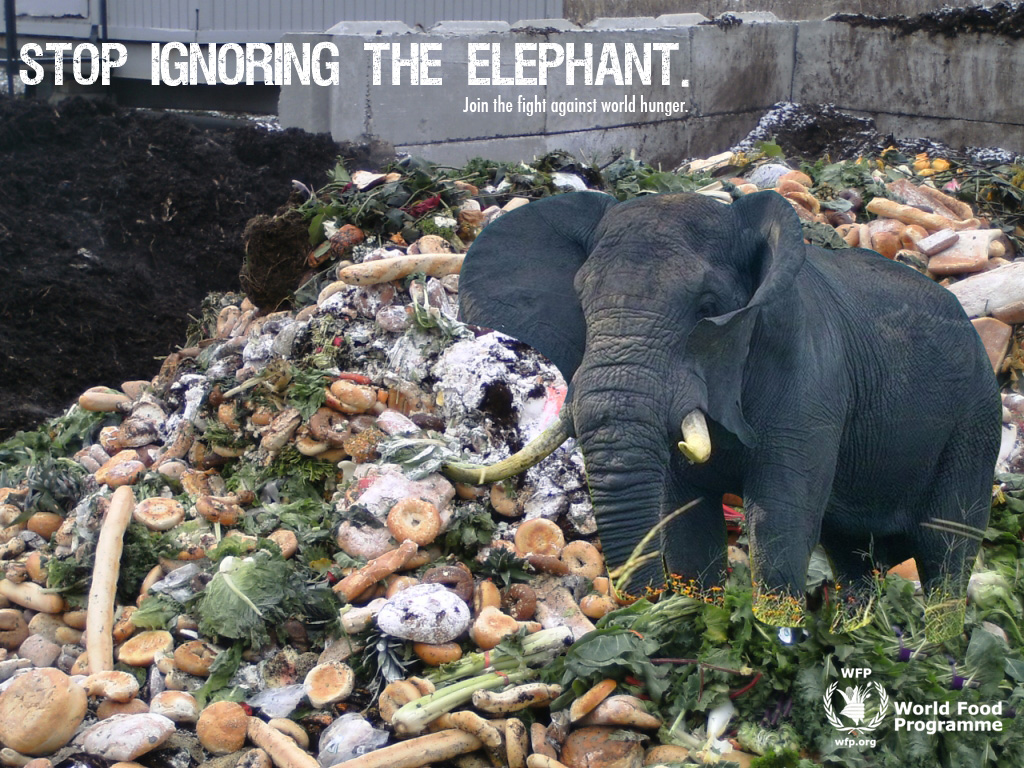
Subscribe to:
Posts (Atom)