Sunday, February 1, 2015
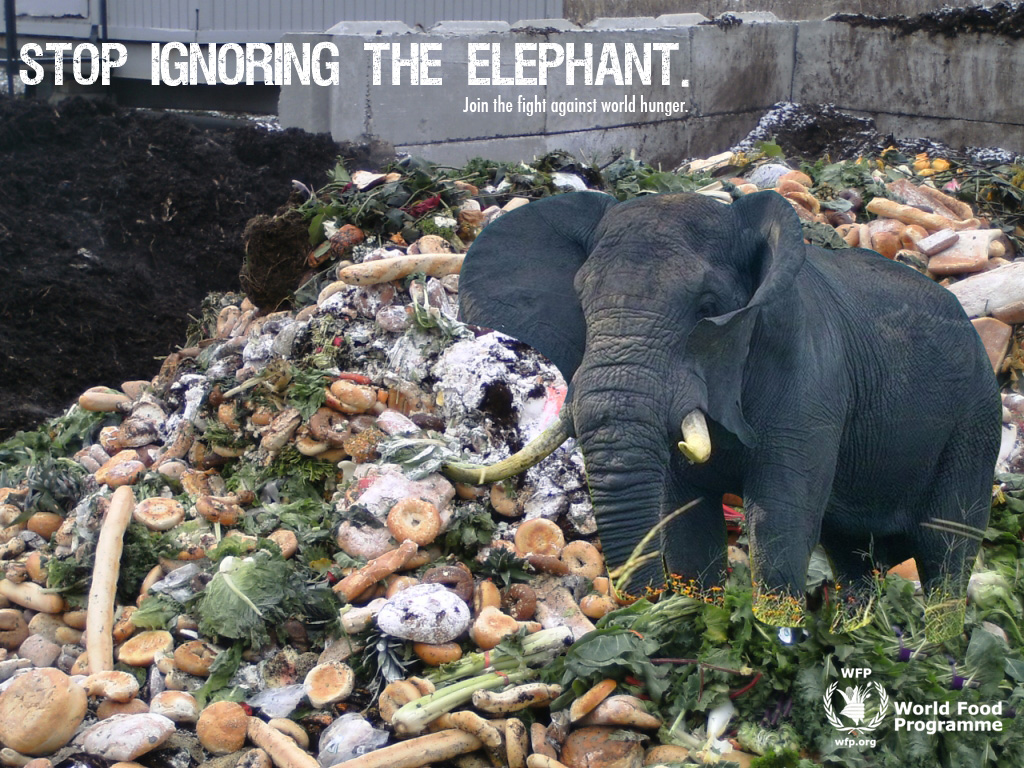
TOW #17 - World Hunger Visual Text
The World Food Programme has worked to aide countries with hunger problems since it was established in 1961, and with this ad they aim to draw attention to the cause. The use of several rhetorical devices, including contrasting images and an allusion, helps grab the audiences attention and sparks an interest or at least a glance towards aiding world hunger. Clearly, the elephant smack dab in the middle of the image grabs the viewer's attention. Initially, the viewer might believe this is an ad for the WWF (World Wildlife Fund), which often times uses cute animals to help their cause in aiding animals globally. However, the WFP is not specifically concerned with animals, but more malnutrition issues. The elephant stands in a enormous pile of food, which goes along with their mission of ending world hunger. The two contrasting images, ideas and causes makes the reader wonder, "Why is an organization using something unrelated to their cause coupled with the exact reason for their cause to prove their point?" The allusion then connects the dots for the audience, in which the text states, "Stop ignoring the elephant. Join the fight against world hunger." This is an allusion to the well-known saying, "we must address the elephant in the room." It is inferable that the elephant in the room is world hunger, and the World Food Programme wants the audiences attention and concern on this important issue. Essentially, the WWP wanted the audience to address the elephant in the picture. The WWP certainly grabs the audiences attention with an allusion to the elephant that contrasts with their purpose, and effectively highlights the concern the audience should have on the issue of world hunger, the elephant in the world.

Sunday, January 18, 2015
TOW #16 - IRB #2 "In Cold Blood" By Truman Capote
"In Cold Blood" by Truman Capote, although a work of nonfiction retelling of the Clutter family murder, has meaning to it as well. The message of "In Cold Blood" is essentially life has happened before you, and life will happen after you; it's looking at the bigger picture rather than viewing the murder as a world-stopping tragedy. This message the author portrays with his twist on the events is shown strongly through his symbolism and his tone. This is clear because the ending scene of the book is completely fabricated by the author, which means it is not to recount history but to actually tie in a message. The tone as Dewey departs the cemetery is wistful, as "she disappeared down the past, a pretty girl in a hurry... Then, starting home, he walked toward the trees, and under them, leaving behind him the big sky, the whisper of wind voices in the wind-bent wheat" (343 Capote). The path the girl takes is symbolic of the future, and the sky behind him is symbolic of the past. The author specifically makes note of these two symbols, rather than ignoring them which would have giving the message "the past and future don't matter." Instead, they symbolism tied in with the wistful and thoughtful tone portrays the message "we must acknowledge and learn from the past, and think about and strive for the future, and life may keep moving but every second is important." Symbolism is used yet again to enforce this message with Nancy's diary. In her diary on the final day of her life, she wrote about the seemingly trivial events of her day. However, the facts that these were her last words in her diary enforces the idea that even the most trivial moments are important enough to pay attention to as if every day were your final day. Capote utilizes strong symbols and tone in order to relay the message that every moment of life, whether it be past, present or future, is never too small to pay attention to and appreciate.
Sunday, January 11, 2015
TOW #15 - "The Destruction of Culture" By Chris Hedges (Written Texts)
Often times, the most challenging task an author can take upon themselves is challenging social norms and a common belief among a civilization. In "The Destruction of Culture," Chris Hedges battles the belief that war is something a person fighting should be proud of, that its a selfless and noble act. Rather, he presents war as it truly is, a demon that can bring forth the destruction of a society. As a man who has witnessed and covered many wars, including those in the Balkans, Central America, and the Middle East, one of the most powerful rhetorical devices he uses to argue his claim is personal anecdotes. As he stands with mourners in Albania, he "pulled back the cloth to uncover the faces. The gouged-out eyes, the shattered skulls, the gaping rows of broken teeth... I stared into their lifeless faces... I could not wholly believe what I saw in front of me. This sense that we cannot trust what we see in wartime spreads throughout the society. The lies about the past, the eradication of cultural, historical, amd religous monuments... We lose our grip" (1043 -1044). By correlating what he viewed for himself and his personal view on the matter to the effect it has on the society as a whole he effectively argues his point that war should be viewed as a death sentence for socety. His logical conclusion also play a part in convincing the reader of this twist on reality. After an interview with the director of a production of Hamlet, he concldues that "Every reporter struggles with how malleable and innacurate memory can be when faced with trauma or stress... They struggle to connect disparate images. And those who see events with some coherency find there is an irreversible pull to twist the facts to conform to the myth" (1046). By providing an explanation to the reader of why these realities get molded into the myth, he allows the reader to follow his train of thought and think, "Okay, I see why that's logical." Through his use of personal anecdotes and drawing logical conclusions, Hedges effectively argues against the common belief that war should be viewed as noble instead of a ticking time bomb on society.
Sunday, December 21, 2014
Tow #14 - Visual Text, Anti-Social Media

As social media blossomed with the advancement of technology, the anti-social media population kept pace trying to at least slow its ever growing popularity. This group of intense protestors includes Pawel Kuczynski, an artist who often creates works of art that challenge issues in American culture. In this piece, Kuczynski speaks to social media lovers and utilizes familiarity as well as coloring and juxtaposition in order to emphasize the reality of what social media really does to a person's life: it can inhibit a person from truly experiencing all life has to offer. A man is portrayed looking through a viewfinder shaped like an "f", which the audience quickly recognizes as the Facebook logo. The audience can also connect the room the man is standing in is similar to that of a jail cell, with its metal bar windows and steel walls. The artist deliberately has the wall open from the cell, so it is clear that the man is so absorbed in the social media and seeing the world through its lens that he does not take advantage in the fact that he can go out and experience it for himself. The monochromatic coloring of the jail cell in contrast to the bright and welcoming colors of the outside environment have the audience thinking, "he is really missing out on that beautiful world outside social media." By placing these two different environments in juxtaposition, it emphasizes the stupidity and ignorance of the social media user because simply a few steps away outside his cell is a completely different and frankly better world. Pawel Kuczynski expertly exposes the dangers of social media in that it can truly hold a user back from living life to the fullest through familiarity, contrasting colors, and juxtaposition.
Sunday, December 14, 2014
Tow #13 - Pitchfork Review of "Chumped" by Teenage Retirement by Devon Maloney (Written text)
Pitchfork is notorious for their blatantly truthful album reviews, and reviewer Devon Maloney does not disappoint with his review of "Chumped" by Teenage Retirement. A few days before its release, Maloney reviewed the album and gave it 7.3 out of 10 points, letting fans know this is not an album they want to miss. Foremost, the jargon he uses especially connects with readers. Most interestingly, he gives a title to a feeling we all know to be true, "umami: that moment in a song when your feelings explode, whether you want them to or not" (1). No matter what genre the reader is a fan of, they can instantly relate and can infer that "Chumped" will give them this feeling of euphoria as well. He also references different bands and albums similar to "Chumped". The album parallels other artists in the way that "there are times when their licks was Weezereque [...] and in several instances ("Long Division") they channel Aye Nako's confessional" (1). By relating it to other artists, the fans of those bands instantly think, "if they're similar to my favorite band, why wouldn't I enjoy their album?" In this way, he effectively convinces his readers that "Chumped" is an album worth listening to. Another act of brilliance not only by Devon Maloney but all Pitchfork staff members is that when reviewing an album, they include a small snippet of whatever album they are reviewing. In this case, they include about 30 seconds of "Novella Ella Ella Eh" and "Hot 97 Summer Jam", both of which he reviews specifically in the review. This method tells the reader, "here, listen, and see that I know what I am talking about." The reader can hear that they like the album for themselves, and then read that the author likes it as well, so it ultimately credits the author for his opinion on the rest of the album. Through detailed jargon, references, and sampling, Devon Maloney upholds Pitchfork's reputation as a brilliant review website in his review of "Chumped" by Teenage Retirement.
Sunday, December 7, 2014
Tow #12 - IRB #1 "In Cold Blood" by Truman Capote
"In Cold Blood" by Truman Capote is the story of the Clutter family's murder and the search for the killer. It takes place in 1959's Holcomb, Kansas; a normally quiet town. When an author is retelling a story, the most import aspect of the retelling in the way the author tells it, specifically through figurative language so the reader is able to completely visually the event as it happened. Truman Capote does an incredible job of incorporating rhetorical devices into the first half of "In Cold Blood" in order to provide the reader with a vivid scene. For example, Capote employs anaphora to set the scene of Holcomb, Kansas. He describes the town "Like the water of the river, like the motorists on the highway, and like the yellow trains streaking down the Santa Fe tracks, drama, in the shape for exceptional happenings, had never stopped there" (5). The repetition in the sentence allows for the reader to connect the similarities between the water, the motorists, and the yellow trains; they are all things that do not stop when they are in motion. The reader then visualizes that the "exceptional happenings" or anything out of the norm does not stop in this quiet town, which draws a striking contrast to the odd murders that occurred here: the focus of his story. Later, he uses a simile to give us a better understanding of the Clutter family's life, more specifically Mrs. Clutter. She suffered from postnatal depression, and that "the mood of misery never altogether lifted; it lingered like a cloud that might rain or might not" (27). This raises questions to the reader: Why would Capote mention this if it was inconsequential? Did her depression correspond to the murders? The comparison between her depression and the rain cloud keeps the audience on their toes and engaged, which helps Capote relay the story. Truman Capote is a professional story teller through his use of rhetorical devices when retelling the story of the Clutter family murders in "In Cold Blood".
Sunday, November 23, 2014
Tow #11 - "In Plain English: Let's Make It Official" by Charles Krauthammer (Written text)
Appearing in 2006's Time magazine, the essay "In Plain English: Let's Make It Official" states the views of author Charles Krauthammer on whether or not English should be deemed the official language of the United States. Krauthammer argues that it should, and his personal anecdotes and acknowledgement of the other side allows him to do so effectively. Right at the start, Krauthammer introduces himself as a bilingual man who grew up in Canada, a country that, "of course, had no choice about bilingualism [...] The U.S., by contrast blessed with a single common language for two centuries, seems blithely and gratuitously to be ready to import bilingualism with all its attendant divisiveness and antagonisms" (Krauthammer 1). He establishes a credibility by explaining his upbringings in a country divided by language, and contrasts it to the US which is ready to tear itself apart by bringing in this bilingualism, even though they have this opportunity to be united under one language. He then goes on to explain his view completely; that it is okay to be bilingual and practice other languages, but it is not okay to demand the U.S. government adhere to that language. When immigrating to the U.S., "the immigrant, of course, has the right to speak whatever he wants. But he must understand that when he comes to the U.S., swears allegiance and accepts its bounty, he undertakes to join its civic culture. In English" (Krauthammer 2). He makes a compelling and logical argument by appealing to the other side. He does not say, "You need to speak English fluently, and English only", which may be the fears of many opposing the term official language in regards to the relationship between the United States and English. He basically says, "You need to understand enough English to participate in our society, where our official documents will be printed in English." This argument in nothing but logical and cannot be refuted. Charles Krauthammer effectively argues his opinion that English should be the official title of the United States though personal anecdotes and addressing the other side of the argument in "In Plain English: Let's Make It Official."
Subscribe to:
Posts (Atom)